AIMA Digital Asset Forum 2026 - Key takeaways
Published: 18 May 2026
AIMA Digital Assets Conference 2026 – Key highlights
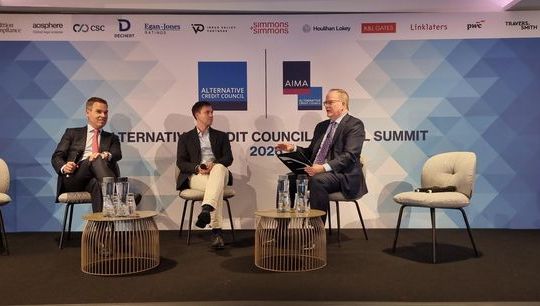
The 5th Annual AIMA Digital Assets Conference took place in New York last week, again bringing together hundreds of industry leaders, including investment managers, allocators, service providers, regulators and policymakers, for a full day of discussion, debate and networking on the evolving digital asset landscape.
Building on the work of the AIMA Digital Assets Working Group (“AIMA DAWG”), the global voice of alternative investment managers in digital assets, the conference dove into how institutions invest in digital assets, while providing ample opportunities to connect with peers worldwide.
Across a series of panels, breakout sessions and networking breaks, participants explored many of the most pressing issues shaping crypto asset markets today, both in the United States and globally. Discussions focused on institutional adoption, market structure, tokenization, stablecoins, ETFs, regulation, litigation, custody and risk management, highlighting both the progress being made across the industry and the challenges that remain as this asset class continues to mature.
Some of the key themes and takeaways from the conference are outlined below.
1. Institutionalization is no longer theoretical – it’s operational
Across nearly every session, the conversation shifted from whether institutions will participate in digital assets to what infrastructure is still missing for them to scale confidently. Discussions repeatedly emphasized institutional-grade custody, governance, transparency, operational resilience and credit frameworks as the next phase of market maturity. Managers, allocators and service providers alike acknowledged that digital assets are increasingly being evaluated through the same operational and risk lens as traditional capital markets.
2. Regulation remains one of the industry’s biggest constraints – and catalysts
A dominant theme throughout the conference was the tension between accelerating innovation and incomplete regulatory clarity. Speakers highlighted how fragmented global regimes, evolving SEC guidance, and uneven enforcement continue to shape business models, market access, onboarding, and product launches. At the same time, many viewed pending legislation such as the GENIUS Act and CLARITY Act and other emerging regulatory frameworks globally as critical catalysts for broader institutional adoption, particularly around stablecoins, custody and tokenized funds and assets.
3. Market structure is evolving away from retail-driven leverage
The post-10/10 discussions reinforced a broader structural shift already underway across digital asset markets. Participants noted declining retail engagement, reduced speculative leverage, and growing demand for more sophisticated instruments including structured products, options, and tokenized assets. The consensus was that future market growth will depend less on leverage-fueled retail activity and more on sustainable institutional participation supported by stronger risk management and deeper liquidity infrastructure. Participants also discussed the rise of cross-asset trading, with more blockchain-focused companies IPO’ing in the public markets, and reflected on the value of tokens going forward.
4. Blockchain and traditional finance rails continue to converge
Tokenization emerged not simply as a product trend, but as a broader redesign of financial market infrastructure. Panels explored how on-chain issuance, settlement, fund structures, stablecoins, and tokenized deposits are reshaping financial markets and operational “plumbing.” While adoption remains early and fragmented, there was growing consensus that tokenization’s long-term significance lies in improving efficiency, programmability, collateral mobility, and global accessibility across both traditional and digital financial systems.
5. Risk management and counterparty oversight have become core differentiators
A recurring takeaway was that risk management is increasingly becoming a competitive advantage rather than merely a compliance function. From custody and counterparty exposure to litigation risk, onboarding, insurance limitations, the advent of quantum computing and market stress events, firms are facing much higher expectations around operational diligence and governance. Participants consistently emphasized that venues and managers capable of demonstrating robust controls, transparency, and regulatory credibility are beginning to separate themselves in an increasingly institutional market environment.
Many thanks to our all of event sponsors, without whom AIMA’s events would not be such a valuable resource for members.
To find out how to get involved in the next AIMA Digital Assets Conference, or join the AIMA Digital Assets Working Group, contact: Michelle Noyes or James Delaney.