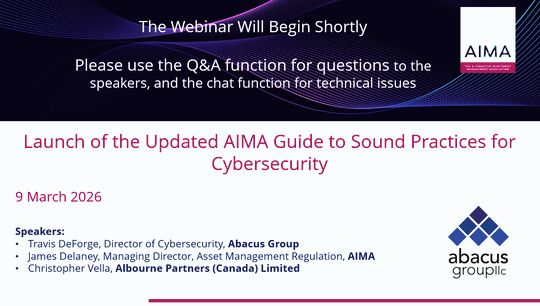
Cybersecurity governance in alternative investment management: Building a resilient operational framework
By Travis DeForge , Abacus
Published: 22 June 2026
This article outlines practical cybersecurity governance principles for hedge fund managers, alternative credit managers, and funds of funds, examining how firms can move beyond compliance box-ticking to embed cyber resilience into their operational and oversight frameworks.
The operational stakes
Cybersecurity has become an unavoidable governance priority for alternative investment managers. For hedge funds and credit managers, the exposure is direct: trading systems, fund accounting platforms, investor data, and proprietary research all represent high-value targets. For funds of funds and multi-manager platforms, the risk is compounded, a manager’s cyber posture is not merely its own concern, but a material factor in the aggregate risk profile of the allocating vehicle.
Cyber incidents at financial firms routinely generate costs upwards of millions of dollars when downtime, forensic investigations, recovery efforts, and regulatory notification are taken into consideration. But direct financial impact is not the only concern. Operational disruption during a live trading period, or the unauthorised disclosure of investor information, can cause lasting damage to a firm’s reputation, investor relationships, and regulatory standing that no balance sheet figure fully captures. Managers that treat cybersecurity as a compliance function, rather than a core operational discipline, are leaving a material blind spot in their risk strategy.
Why alternative managers face elevated exposure
The operational model of many alternative managers creates conditions in which cyber risk can accumulate faster than controls mature. Several characteristics amplify this vulnerability:
Rapid growth and platform change. Expansion into new strategies, additional prime brokerage relationships, or third-party administrator migrations introduces new data flows and access points that may outpace the firm’s security architecture.
Complex third-party ecosystems. Fund administrators, technology providers, cloud platforms, data vendors, and outsourced IT functions each represent a node on the firm’s extended attack surface. Without adequate oversight and controls in place, a vulnerability in a service provider can become a vulnerability in the fund.
Lean security functions. Many mid-market managers have not yet built dedicated in-house cybersecurity capabilities or invested in a specialised outside provider. Security responsibilities are frequently distributed across IT generalists or shared with operations, leaving critical gaps in monitoring and response readiness.
Uneven baseline controls. Even well-resourced firms can exhibit inconsistencies in foundational hygiene, patching cadences, multi-factor authentication (MFA) coverage, access controls, and backup integrity, particularly where infrastructure has grown organically over time.
Increasing investor and regulatory scrutiny. Institutional allocators now routinely include cybersecurity assessments in operational due diligence and regulators in major markets have introduced or are developing specific expectations around cyber risk governance. A credible programme is increasingly a prerequisite for capital raising, not merely a back-office nicety.
A practical governance framework
Building a mature cybersecurity posture does not require a firm to overhaul its entire infrastructure overnight. A phased, risk-prioritised approach, one that establishes a consistent baseline and repeatable governance process, is both more achievable and more durable. The following elements are essential.
Conduct regular baseline risk assessments
No two firms carry identical risk profiles. Infrastructure complexity, third-party relationships, regulatory obligations, and the sensitivity of data handled all vary. A structured baseline assessment provides a ranked view of operational and technical gaps across key domains: identity and access management (IAM), endpoint security, cloud infrastructure, critical business applications, and information security policies.
Assessments should be conducted on an annual cycle, at a minimum, but also if there is:
- Material operational change in a new platform migration
- A new outsourcing arrangement
- A significant headcount expansion
The output should be a prioritised risk register that can be reviewed meaningfully by senior management and, where appropriate, reported to the board or investors.
Define and track key security metrics
What gets measured gets managed. Managers should establish a consistent set of security performance indicators that allow them to track posture over time, identify deterioration early, and demonstrate continuous improvement to stakeholders. Relevant metrics include:
- MFA coverage: the proportion of users, systems, and applications protected by multi-factor authentication
- Endpoint protection deployment: the extent of detection and response tooling across workstations and servers
- Patch management compliance: adherence to defined timelines for remediating critical and high-severity vulnerabilities
- Open vulnerability count: unresolved vulnerabilities tracked by severity and age
- Incident response readiness: completion of required exercises such as annual tabletop simulations
Regular review of these indicators at the senior management level drives accountability and supports the kind of evidence-based reporting that institutional investors and regulators increasingly expect.
Formalise a Written Information Security Programme (WISP)
Documented policies are the foundation of any defensible security posture. A Written Information Security Programme (WISP) translates the firm’s security requirements into clear, enforceable expectations that staff, vendors, and service providers can follow consistently. It also creates an audit trail that demonstrates the firm’s governance approach to regulators and allocators.
A practical WISP should establish non-negotiable minimum standards MFA adoption, least-privilege access controls, backup management, and incident reporting procedures while retaining the flexibility to address the firm’s specific data types, operational model, and regulatory obligations. Ownership and review responsibilities should be clearly assigned at the senior level, with a defined cadence for policy refresh as the threat environment evolves.
Implement a structured remediation roadmap
Once gaps are identified and policies are in place, remediation must be sequenced and resourced. Firms should prioritise the highest-risk exposures first, which are gaps with the greatest potential for operational disruption or data loss, and build phased milestones that allow steady progress without disrupting day-to-day operations.
Implementation toolkits, technical guidance, and standardised vendor arrangements can accelerate adoption and reduce cost. Where firms operate multiple legal entities or managed accounts platforms with distinct infrastructure footprints, a templatised approach to the baseline process ensures that new operational environments are onboarded to the same security standard from day one.
From compliance to resilience
The direction of industry standards is clear: regulators, institutional investors, and counterparties will only increase their expectations around cybersecurity governance in the years ahead. For alternative investment managers, the question is no longer whether to take cyber risk seriously, but how to build a programme that is proportionate, credible, and continuously improving.
Firms that embed cybersecurity into their operational governance rather than treating it as a periodic compliance exercise will be better placed to protect investor capital, sustain institutional relationships, and compete in an environment where operational due diligence has become as important as investment track record.