Key takeaways – AIMA’s Annual APAC Forum 2026
Published: 10 November 2026
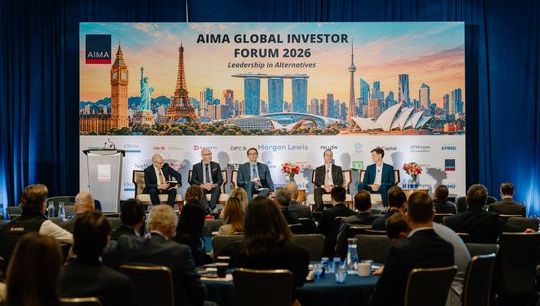
From private credit and the evolving alternative investment landscape to investor priorities, technology and the future of the industry, AIMA’s Annual APAC Forum 2026 welcomed industry leaders, fund managers, investors and partners to exchange perspectives, explore new opportunities and catch up with familiar faces.
A big thank you to our speakers, sponsors, and everyone who joined us in making the week such a success.
Here are the key takeaways from the day:
Asia is under-allocated, country by country
Australia is the region’s most mature market, although it is facing property-related stresses. India is seeing record deal flow, with GIFT City emerging as a new centre of activity. In Southeast Asia, banks and private credit providers are forming consortia, and each market is following a different trajectory.
Meanwhile, turbulence in the US is drawing LP interest towards Asia as a relative-growth story.
A multipolar world is reshaping capital flows
The dollar remains dominant, but de-dollarisation is under way. Gulf capital is diversifying towards Hong Kong and Singapore, while exposure to China is increasingly routed through regional structures.
Away from traditional finance, tokenisation remains the durable trend, with regulated regimes already in place in Hong Kong and Singapore.
Tax and regulation: Hong Kong and Singapore are competing on carried interest
In Hong Kong, years of sustained AIMA-led advocacy helped reframe the debate from “lost revenue” to “economic opportunity”. In the end, every industry ask was delivered in the final framework, as mentioned in the Acting Secretary’s keynote speech at the forum.
In Singapore, the Monetary Authority of Singapore’s (MAS) 19 August package matched all three pillars—economics, capital and talent—of AIMA’s Compounding the Singapore Advantage letter, which had been submitted four weeks earlier. On the day of the announcement, MAS listed AIMA as its industry contact for media.
Investor Xchange: allocator feedback, and AIMA flipped the cap-intro model
The second edition of AIMA’s “reverse cap intro” gave allocators the chance to educate managers, reversing the usual format. The feedback from some GPs was that it gave them real access to allocators.
Allocators told managers that selection has moved “from journalism to analysis”. Data, scalability and track record now count for more than pedigree, and capacity is the first question. Face-to-face contact and trust remain non-negotiable, while project and asset quality carry more weight than the manager.
Australia was repeatedly flagged as a leading allocation target, but, in the closing discussion at the Forum, Hong Kong’s carried interest reform was cited as “an extremely strong demonstration” of the government’s commitment to the industry.
Private credit is broadening and maturing
It has been a record year for fundraising, and corporate lending no longer defines the asset class. Asset-backed finance, real estate, AI infrastructure and consumer lending are all growing.
Panellists described how durable growth depends on underwriting discipline, workout capability, talent and clarity on enforcement. These are the same principles codified in AIMA’s guidance.
The wealth channel is the structural shift, and investor education is core AIMA territory
The penetration of alternatives in Asia remains far below that of the US. Evergreen structures sell convenience rather than liquidity, and distributions must come from real, cash-generative assets.
Panellists highlighted the work of the Alternative Credit Council (ACC) in helping investors understand returns composition and described investor education as core AIMA tenet.
Insurance capital is the next big pool
Asian insurers lag behind their US and European counterparts in private credit, with one of the main barriers being the capital treatment of unrated and securitised assets.
From the stage, the ACC was credited with making EU securitisation reform a top advocacy priority “to unlock more capital coming from insurers to private credit”.
In Singapore, AIMA’s Project Unlock is leading engagement with MAS on Notice 133. The discussions cover quarterly versus monthly valuation data, the securitisation capital loading, and the treatment of unrated assets.
AI: financing boom, investment tool and threat vector
Private credit is emerging as a major financier of AI infrastructure. In this area, contractual rights matter more than liens on depreciating GPUs, and firms must also account for the APAC export-control environment.
Allocators are using AI for due diligence but warn that it could lead to more homogeneous decisions. AI amplifies expertise rather than replacing it.
AI has also lowered the cost of cyberattacks. As one panellist put it, “Outsourcing IT does not mean outsourcing responsibility”.